Home · Time and discovery
Time and discovery
From a name in 1878 to a hall in 1907
Diplodocus was first described as a new type of dinosaur in 1878 by Professor Othniel C. Marsh at Yale University. [NHM] Railroad workers unearthed fossilised bones of a Diplodocus in Wyoming, USA, in 1899. [NHM] Museum director William J. Holland organised an expedition to the American west in 1899. [Carnegie Museum] After three months of searching, a team member discovered a huge toe bone at Sheep Creek, Wyoming. [Carnegie Museum]
The bones were sent back to Pittsburgh in 130 crates. [Carnegie Museum] In 1901, Carnegie Museum palaeontologists named a new species Diplodocus carnegii. [Carnegie Museum] The new species was named Diplodocus carnegii in honour of Andrew Carnegie. [NHM]
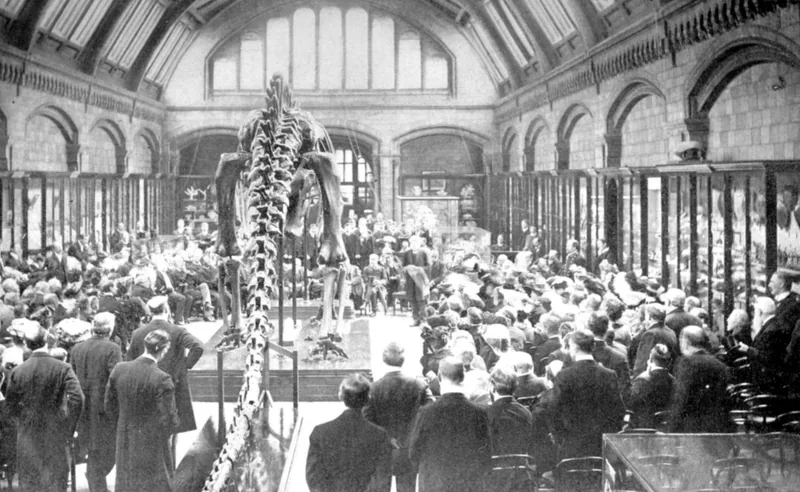
The London cast was unveiled for the first time on 12 May 1905. [NHM Dippy] The 292-bone skeleton arrived in London in 36 packing cases and was unveiled on Friday 12 May 1905. [NHM] Dippy settled into a permanent home in 1907 as the first dinosaur in the new Dinosaur Hall. [Carnegie Museum] By the time the museum’s expansion was finished, people in Pittsburgh called the museum “The House That Dippy Built.” [Carnegie Museum]
In 1979, Dippy moved to Hintze Hall, remaining there until 2017. [NHM] Dippy’s last day on show in London was 4 January 2017. [NHM]
A range of years, not a single clock
On the directory, Diplodocus lived in the Late Jurassic, 152–145 million years ago. [NHM Directory] The Museum’s life of Dippy says the species lived sometime between 156 and 145 million years ago. [NHM] Encyclopaedia Britannica places Diplodocus in the Late Jurassic Period, 161 million to 146 million years ago. [Britannica]
The discovery dates are firm. The animal’s lifetime in the Late Jurassic is published as more than one range. Both facts can be true at once.