Home · Dippy
Dippy
A plaster celebrity, not the original bones
Dippy is the name the Natural History Museum gave its Diplodocus cast. The original skeleton is in Pittsburgh.
Dippy is a plaster-of-Paris replica of a Diplodocus carnegii, whose original skeleton is at the Carnegie Museum. [NHM Dippy] In 1905, the directory notes, Andrew Carnegie donated a cast of a Diplodocus skeleton to the Natural History Museum, based on the original specimen in the Carnegie Museum. [NHM Directory] The London cast was unveiled for the first time on 12 May 1905. [NHM Dippy]
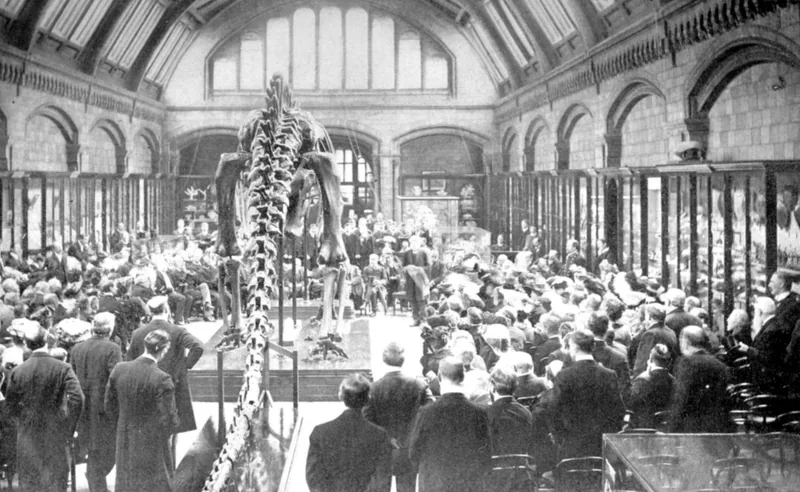
The 292-bone skeleton arrived in London in 36 packing cases and was unveiled on Friday 12 May 1905. [NHM] Dippy is one of 10 replicas of the original D. carnegii in museums around the world, including Paris, Berlin, Vienna, and Moscow. [NHM]
The 1905 photograph looks along the tail toward Lord Avebury, speaking at the unveiling. It is a record of that day, not a modern gallery shot.
In 1979, Dippy moved to Hintze Hall, remaining there until 2017. [NHM] Dippy’s last day on show in London was 4 January 2017. [NHM] Following research in the 1960s, the neck was raised to a horizontal position, and in 1993 the tail was repositioned to curve over visitors’ heads. [NHM]
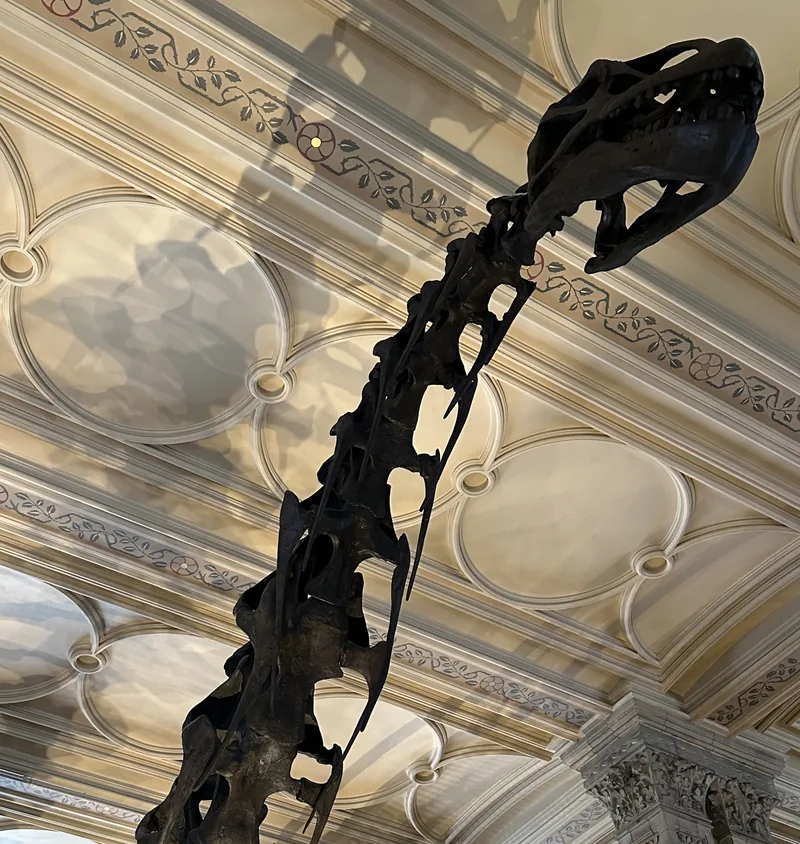
The 2026 photograph shows Dippy at the Natural History Museum, London. It is not a picture of the Hintze Hall years that ended on 4 January 2017.
The new species was named Diplodocus carnegii in honour of Andrew Carnegie. [NHM]
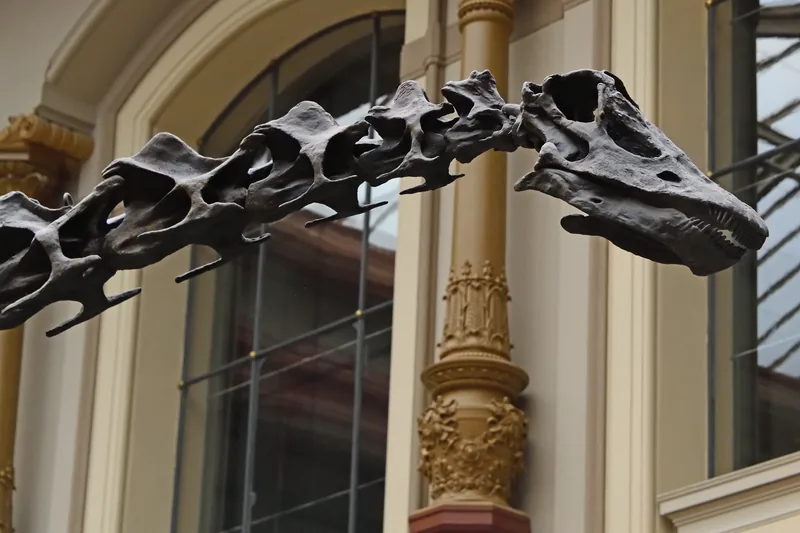
Berlin has one of the ten replicas. The close-up above is the head and neck of that cast, photographed in 2021.