Home · The animal
The animal
A sauropod with a comb of teeth and a double-beamed tail
The outline is familiar: a small head, a very long neck, four pillar-like legs, and a tail that goes on for most of the length.
The same directory lists the type of dinosaur as a sauropod. [NHM Directory] The directory lists the diet as herbivorous. [NHM Directory] The Natural History Museum’s Dino Directory gives the name meaning as ‘double beam’. [NHM Directory] The directory says it is found in the USA. [NHM Directory]
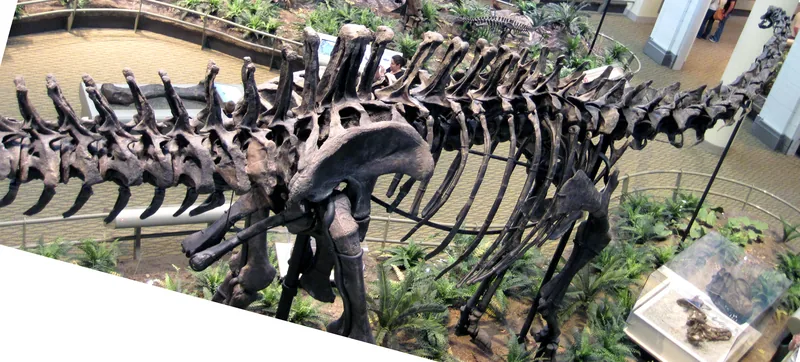
On the directory, Diplodocus lived in the Late Jurassic, 152–145 million years ago. [NHM Directory] Skeletons of this dinosaur are found in the Morrison Formation in North America. [NHM Dippy] The Dippy page places the animal in the Late Jurassic, 155-145 million years ago. [NHM Dippy]
Four ways to date the same period
On the directory, Diplodocus lived in the Late Jurassic, 152–145 million years ago. [NHM Directory] The Museum’s life of Dippy says the species lived sometime between 156 and 145 million years ago. [NHM] The Dippy page places the animal in the Late Jurassic, 155-145 million years ago. [NHM Dippy] Encyclopaedia Britannica places Diplodocus in the Late Jurassic Period, 161 million to 146 million years ago. [Britannica]
All four sources place Diplodocus in the Late Jurassic. The years they print are not identical. The length-and-scale desk keeps them together rather than choosing one quietly.
Britannica describes the skull as unusually small and rather light, elongate like that of a horse, sitting atop a very long neck. [Britannica] The name refers to double-beamed chevron bones under the tail. [NHM Dippy]
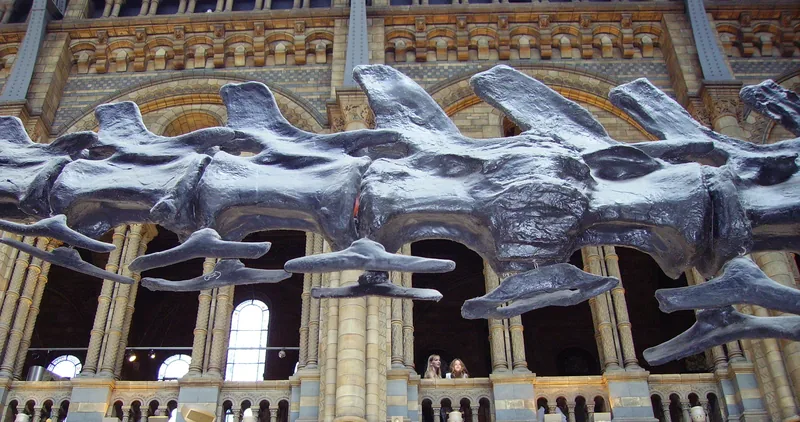
The same article says the tail was very long and probably extremely flexible, and that it may have functioned as a defensive weapon, or as a prop for the hindlimbs. [Britannica]
Britannica is careful with that tail: it may have been a defensive weapon, or a prop for rearing. Those are published suggestions, not a film still.