Home · The length-and-scale desk
Length and scale
How long was it, and compared with what?
Museums and papers do not all print the same length for this animal, or for the famous Carnegie mount. The disagreement is useful, once the figures stay labelled.
Choose a topic. The table below stays put. It is the same set of published figures, seen together, not a different record.
Directory length
The directory gives the length as 26.0 m. [NHM Directory] The directory gives the weight as 15,000 kg. [NHM Directory]
One clean figure, 26.0 m, and a weight of 15,000 kg. It is a good place to start, and not the only published number.
Directory length
The directory gives the length as 26.0 m. [NHM Directory] The directory gives the weight as 15,000 kg. [NHM Directory]
One clean figure, 26.0 m, and a weight of 15,000 kg. It is a good place to start, and not the only published number.
A 24-to-26-metre range
The same page says the animal Dippy is a replica of was 24 to 26 metres long and probably weighed up to around 15 tonnes. [NHM Dippy] For comparison, the Museum says a London double-decker bus is around 14 metres long and weighs 12 tonnes. [NHM Dippy]
The Dippy page talks about the animal the cast represents, then puts a London bus beside it: around 14 metres, and 12 tonnes.
An 85-foot dinosaur
The Carnegie Museum describes Dippy, at the time of the discovery, as an 85-foot-long dinosaur. [Carnegie Museum] In 1901, Carnegie Museum palaeontologists named a new species Diplodocus carnegii. [Carnegie Museum]
Eighty-five feet is about 25.9 metres. That conversion is ours, from the Carnegie Museum’s wording, not a new measurement of the mount.
The 2025 measurements
Taylor, Wedel and Moacdieh (2025) note that numerous divergent length measurements exist for this specimen, but that the current mount is about 26.1 m long based on photogrammetric and LIDAR models. [Taylor et al. 2025] Their photogrammetric model gave 6.76 m for the head and neck, 3.78 m for the trunk, and 15.51 m for the tail, totaling 26.05 m. [Taylor et al. 2025] A LIDAR-based model gave a total of 85 feet, 8+11/16 inches, which they equate to 26.13 m. [Taylor et al. 2025]
The two models of the current Carnegie mount, 26.05 m and 26.13 m, sit close to the directory’s 26.0 m. The paper is also frank that earlier published lengths had diverged.
Weight
The directory gives the weight as 15,000 kg. [NHM Directory] The same page says the animal Dippy is a replica of was 24 to 26 metres long and probably weighed up to around 15 tonnes. [NHM Dippy] Britannica says that while most of these dinosaurs weighed slightly more than 30 tons, some members of the genus may have weighed as much as 80 tons. [Britannica]
Fifteen thousand kilograms, around 15 tonnes, slightly more than 30 tons, and as much as 80 tons are not the same claim. The first two are Museum figures for this animal; Britannica is writing about the genus, with a much higher range. They stay labelled.
When it lived
On the directory, Diplodocus lived in the Late Jurassic, 152–145 million years ago. [NHM Directory] The Dippy page places the animal in the Late Jurassic, 155-145 million years ago. [NHM Dippy] The Museum’s life of Dippy says the species lived sometime between 156 and 145 million years ago. [NHM] Encyclopaedia Britannica places Diplodocus in the Late Jurassic Period, 161 million to 146 million years ago. [Britannica]
Four published date ranges, from four pages, all Late Jurassic, and not worded identically. The desk does not pick one and hide the others.
What is mounted
The bulk of the skeleton is the holotype CM 84; the paratype CM 94, a referred specimen CM 33985, and a related-species specimen CM 307 provide more fossil material. [Taylor et al. 2025] Significant parts of the mount are casts or sculptures, including the skull, atlas, numerous caudal vertebrae, the forelimbs, and most of the left hind limb. [Taylor et al. 2025] Dippy is a plaster-of-Paris replica of a Diplodocus carnegii, whose original skeleton is at the Carnegie Museum. [NHM Dippy]
The famous Carnegie skeleton is a composite, with casts and sculptures in important places, including the skull. Dippy, in London, is a plaster-of-Paris replica of that animal.
Swipe to see the whole table.
| Source | Figure | How to read it |
|---|---|---|
| NHM Dino Directory length | 26.0 m | A single figure, from the Museum’s directory page. |
| NHM Dippy page length | 24 to 26 metres | A range, on the page about the London cast. |
| Carnegie Museum, “85-foot-long” | 85 feet (about 25.9 m) | The Museum’s wording; the metre figure is a conversion of those 85 feet, not a new measurement. |
| Taylor et al. 2025, current mount | about 26.1 m | From photogrammetric (26.05 m) and LIDAR (26.13 m) models of the Carnegie mount as it stands now. |
| NHM Dippy page weight | up to around 15 tonnes | The directory lists 15,000 kg for the animal. |
| Britannica weight | slightly more than 30 tons; some as much as 80 tons | A different published estimate, for the genus, not averaged with the Museum figures. |
| A London double-decker bus | around 14 metres, 12 tonnes | The Natural History Museum’s own comparison, on the Dippy page. |
Checked on 15 November 2026. The desk does not average these numbers. Where a source gives a range, or a different unit, that is kept.
For comparison, the Museum says a London double-decker bus is around 14 metres long and weighs 12 tonnes. [NHM Dippy] The same page says the animal Dippy is a replica of was 24 to 26 metres long and probably weighed up to around 15 tonnes. [NHM Dippy]
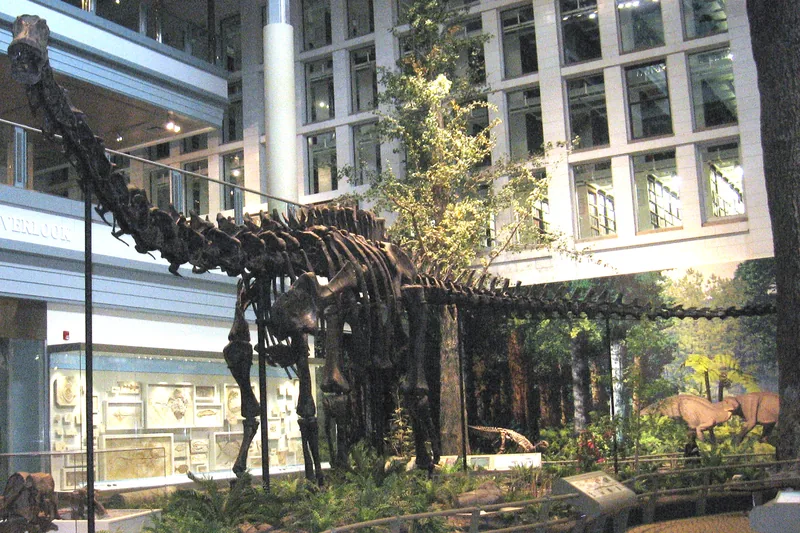
The photograph is the Carnegie mount in Pittsburgh, a composite skeleton. The numbers in the table come from published pages about that mount, about the animal, and about the London cast.