Explore dinosaurs.im
Diplodocusdinosaurs.im

Home · Bones and the name

Bones and the name

Double beam, composite mount, careful skull

The Natural History Museum’s Dino Directory gives the name meaning as ‘double beam’. [NHM Directory] The name refers to double-beamed chevron bones under the tail. [NHM Dippy]
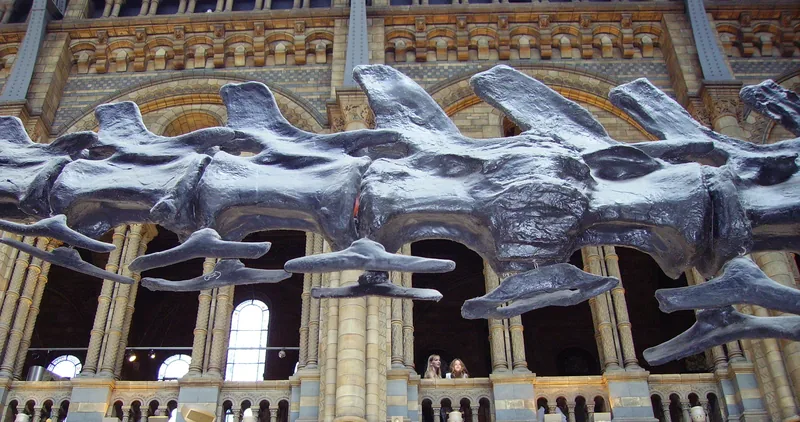
A close-up of large tail vertebrae hanging in a museum hall, with paired chevron bones projecting beneath them and two visitors on a balcony behind
Caudal vertebrae of Dippy at the Natural History Museum, London, showing the double-beamed chevron bones under the tail that the genus name refers to. Photographed by Ballista. Hintze Hall’s architecture is visible behind the tail.Ballista · CC BY-SA 3.0

The hanging bones under the tail are the chevrons. The genus name points at their double-beamed shape, which is a better origin story than a marketing slogan about length.
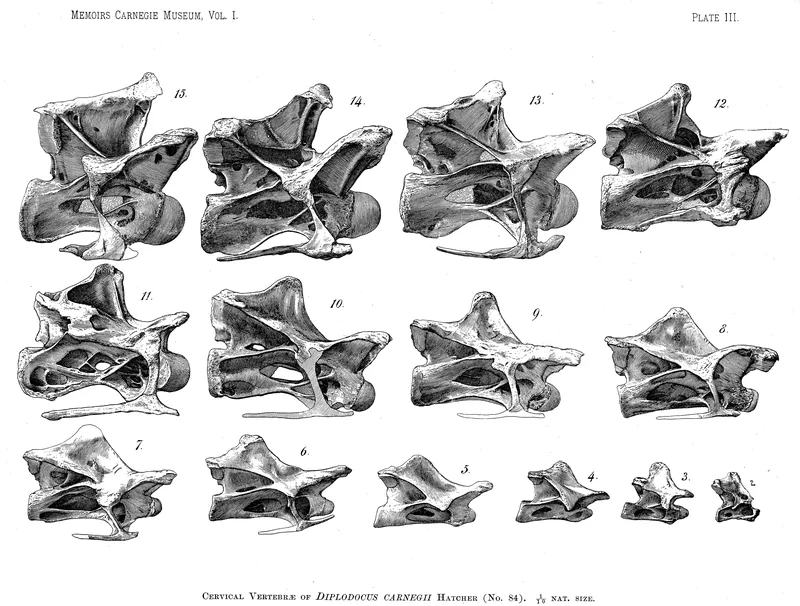
A historical scientific plate showing a row of elongated Diplodocus neck vertebrae drawn in side view, labelled along the column
Cervical vertebrae 2 to 15 of Diplodocus carnegii, a plate from J. B. Hatcher’s 1901 monograph. This is a scientific illustration, not a photograph of the bones.J. B. Hatcher · Public Domain

The bulk of the skeleton is the holotype CM 84; the paratype CM 94, a referred specimen CM 33985, and a related-species specimen CM 307 provide more fossil material. [Taylor et al. 2025] Significant parts of the mount are casts or sculptures, including the skull, atlas, numerous caudal vertebrae, the forelimbs, and most of the left hind limb. [Taylor et al. 2025]
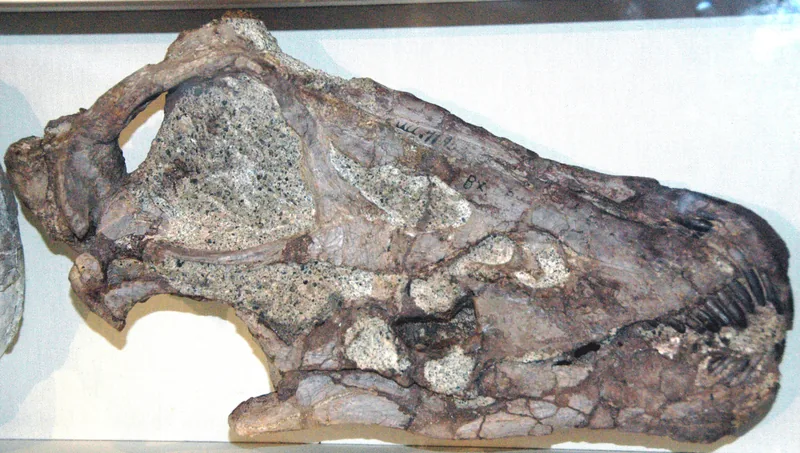
A long, low fossil sauropod skull photographed from the side against a black background, with slender teeth in the jaws
A complete juvenile sauropod skull, 29.2 cm long, on display as CM 11255 at the Carnegie Museum of Natural History, photographed by James St. John on 7 March 2009. It comes from the Carnegie Quarry at Dinosaur National Monument, Utah. The Commons file identifies it as Diplodocus sp., or possibly Diplodocinae indeterminate, or Barosaurus — so this is not presented here as a definite Diplodocus carnegii skull.James St. John · CC BY 2.0

The skull in that photograph is a beautiful, complete juvenile specimen, and the file does not treat it as a definite Diplodocus carnegii skull. That caution is the point of showing it here.

Britannica describes the skull as unusually small and rather light, elongate like that of a horse, sitting atop a very long neck. [Britannica]

Sources on this page