Home · Credits
Credits
Photographs and one 1901 plate
Every image on this site is credited below. Files were resized for the web; none were upscaled, and no other changes were made. Paid printables use only public-domain or CC BY images. Two photographs are CC BY-SA and stay on the website only.
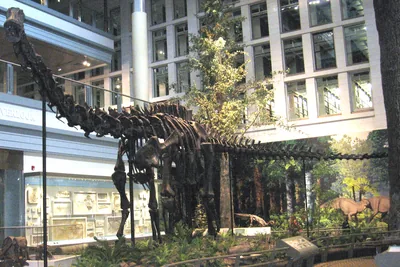
James St. John · CC BY 2.0
The mounted Carnegie Diplodocus in the Dinosaurs in Their Time gallery at the Carnegie Museum of Natural History, Pittsburgh, photographed on 30 January 2011. The mount is a composite of CM 84, CM 94 and CM 307, not a single complete skeleton.
James St. John, 30 January 2011. CC BY 2.0. Carnegie Museum of Natural History, Pittsburgh. Source file. May be used in paid printables (public domain, CC0 or CC BY).
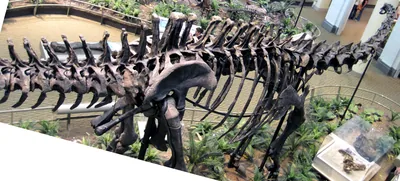
James St. John · CC BY 2.0
A high view of the same Carnegie mount, photographed on 25 July 2010, showing the vertebral column, pelvis and the long tail. The white corner at lower left is in the original photograph.
James St. John, 25 July 2010. CC BY 2.0. Carnegie Museum of Natural History, Pittsburgh. Source file. May be used in paid printables (public domain, CC0 or CC BY).
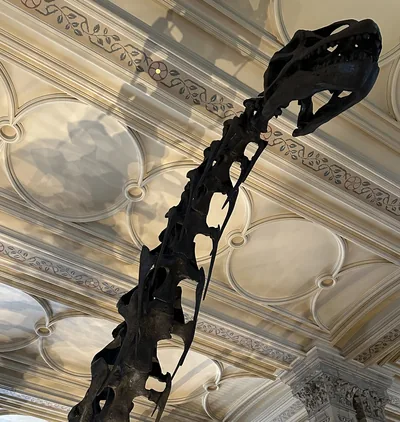
APK · CC BY 4.0
Dippy the Diplodocus, photographed at the Natural History Museum, London, on 13 May 2026. The file is titled with that name; the photograph is not a record of Dippy’s earlier years in Hintze Hall, which ended on 4 January 2017.
APK, 13 May 2026. CC BY 4.0. Natural History Museum, London. Source file. May be used in paid printables (public domain, CC0 or CC BY).
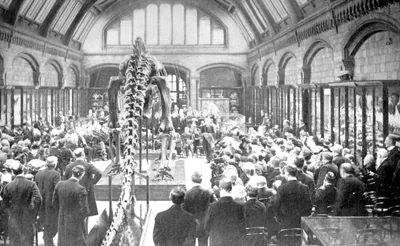
Unknown photographer · Public Domain
The presentation of the first Diplodocus replica to the trustees of the Natural History Museum, London, on 12 May 1905, with Lord Avebury speaking. The photograph looks along the tail and hips of the newly unveiled cast.
Unknown photographer, 12 May 1905. Public domain. Source file. May be used in paid printables (public domain, CC0 or CC BY).
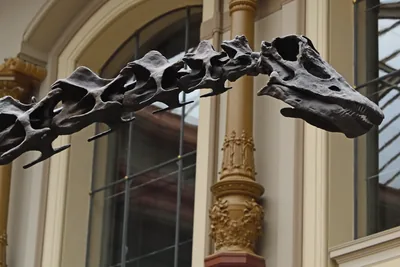
Dosseman · CC BY-SA 4.0
The head and neck of the Diplodocus carnegii cast in the Museum für Naturkunde, Berlin, photographed by Dosseman on 28 September 2021. The Commons file is titled as that skeleton. The file’s description quotes a Brachiosaurus hall notice and does not describe this photograph; the long, low skull in the picture is a diplodocid, not Brachiosaurus.
Dosseman, 28 September 2021. CC BY-SA 4.0. Used on this website only, not in paid printables. Museum für Naturkunde, Berlin. Source file. Used on this website only, not in paid printables (CC BY-SA).
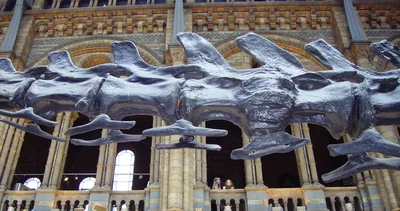
Ballista · CC BY-SA 3.0
Caudal vertebrae of Dippy at the Natural History Museum, London, showing the double-beamed chevron bones under the tail that the genus name refers to. Photographed by Ballista. Hintze Hall’s architecture is visible behind the tail.
Ballista. CC BY-SA 3.0. Used on this website only, not in paid printables. Natural History Museum, London. Source file. Used on this website only, not in paid printables (CC BY-SA).
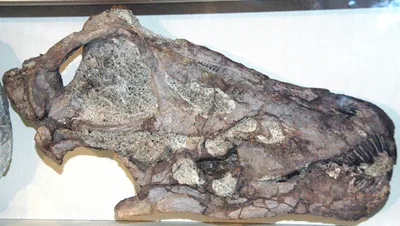
James St. John · CC BY 2.0
A complete juvenile sauropod skull, 29.2 cm long, on display as CM 11255 at the Carnegie Museum of Natural History, photographed by James St. John on 7 March 2009. It comes from the Carnegie Quarry at Dinosaur National Monument, Utah. The Commons file identifies it as Diplodocus sp., or possibly Diplodocinae indeterminate, or Barosaurus — so this is not presented here as a definite Diplodocus carnegii skull.
James St. John, 7 March 2009. CC BY 2.0. Carnegie Museum of Natural History, Pittsburgh. Identification on the file is cautious. Source file. May be used in paid printables (public domain, CC0 or CC BY).
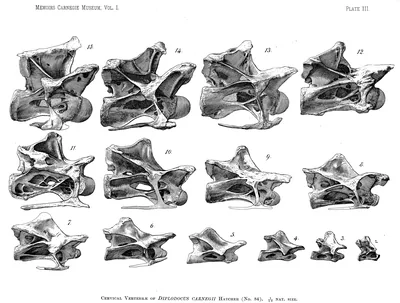
J. B. Hatcher · Public Domain
Cervical vertebrae 2 to 15 of Diplodocus carnegii, a plate from J. B. Hatcher’s 1901 monograph. This is a scientific illustration, not a photograph of the bones.
J. B. Hatcher, 1901, Memoirs of the Carnegie Museum 1. Public domain. Illustration, not a photograph. Source file. May be used in paid printables (public domain, CC0 or CC BY).